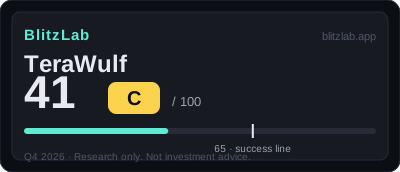
TeraWulf — Blitz Index 41 (C)
A $19B contract on paper — the purest contract-first blitz.
Confidence: Medium · Category: ai-infra
Score breakdown
| Section | Score | Detail |
|---|---|---|
| A · Speed | 14 / 25 | HPC lease $0 → $31.9M/quarter (+52% QoQ); total revenue −6% YoY (mining collapse) |
| B · Moat | 30 / 60 | Anthropic 401MW 20-yr direct lease; 102MW online; 2.3GW power portfolio |
| C · Creative destruction | 9 / 15 | Self-disruption: bitcoin mining → AI hosting (HPC now 71% of revenue) |
| D · BlitzFailing | −12 | D1 full trigger (−10): debt $4B+ = ~24x TTM; interest exceeds negative adj. EBITDA |
Radar axes (0–100): Moat 50 · Speed 56 · Creative 60.
Watch item
Gates: G1 pass · G2 pass. 24 below threshold — first-ever score. 3 points below the BlitzFailing watch flag (15).
Strengths
- Anthropic 20-year direct lease (~401MW, ~$19B, 8-K) — strongest single contract of the four
- HPC lease revenue $31.9M (+52% QoQ) at 86% direct margin (SEC)
- Muskie power contract expanded 500MW → 1GW (Oct 2026, 8-K)
- $3.0B cash — near-term liquidity buffer
Concerns
- Debt $4B+ = ~24x TTM — most extreme leverage of the four (D1 −10)
- Anthropic delivery starts H2 2027 — the future on paper until then
- GAAP net loss −$940M/quarter; operating cash flow −$154M (6 months)
- Customer concentration: Anthropic + Fluidstack are effectively everything
Research notes
1. Current Position — The Contract Blitz (the Engine Starts in 2027)
TeraWulf is **the purest contract-first blitz**. 20-year direct lease with Anthropic on 2026-07-06 (~401MW, initial contracted revenue ~$19B — SEC 8-K Exhibit 99.1, confirmed) + 168MW Fluidstack lease (July amendment, 10-Q) + the 2026-10-01 Muskie campus power contract of 500MW → 1GW expansion (ramping 2028~, 8-K confirmed). The new business's PMF is proven by contracts — the basis for the G1 pass. Contract backlog ($19B) ÷ TTM revenue (~$165M, SEC + press-reported synthesis) ≈ **115x** — nearly 4x the NBIS ratio (~30x).
2. Blitzscaling Lens
**Rule 8. "Raise Too Much Money" — but time was bought with borrowed money.** WULF is the most extreme variant of Rule 8. Term debt $3.2B + convertibles ~$1.0B + cash $3.0B (SEC confirmed) + Google backstop (Fluidstack lease, 10-Q confirmed) — financing capacity is strong (A2 3 points). But Rule 8 says "running out of money mid-race is fatal, so secure runway even at dilution"; WULF accepted dilution (shares 435M → 499M, frequent Form 4, SEC confirmed) AND debt — **fuel on both sides**.
3. Competitive Landscape — The Hosting/Campus Developer Cohort
**The designated competitors** sit inside the hosting/campus developer cohort. APLD (market cap ~$7B, contracted revenue ~$36B — 1.41GW+, 15-year take-or-pay, press-reported) — the textbook land-grab pattern. CIFR (market cap ~$5.4–5.6B, Barber Lake etc., Fluidstack + AI lab lease contracted revenue $9B+, total backlog in the $11B range, large AWS contract — press-reported). CORZ (market cap ~$4.8–5B, contracted capacity ~1.1GW, base contracted revenue $24B+, AMD 530MW — press-reported) — the **Chapter 11 filing of 2022-12 → revival of 2024-01** is the key variable of blitz analysis (candidate reference). All three belong to the same "miner→AI DC" transition family as WULF.
4. Inflection Points
**Inflection Point 1. Friday 11/6 Q3 earnings — the first observation point.** What to watch: the QoQ trend of HPC lease revenue (whether +52% repeats — Q2 $31.9M, SEC confirmed) is the first observation metric. Whether consolidated revenue absorbs the mining collapse (29% residual exposure) and returns to growth, the burn rate of cash ($3.0B, 6/30 — SEC confirmed), and whether CB-4's phased H2 2026 delivery schedule is kept. And since it is the first quarter after the Muskie 1GW contract (10/01), whether the company issues its next capex·financing guidance. Before v1.1 candidate 3 ("B2 discount for pre-delivery contracts") is formalized, only recognized revenue moves the score — the $19B is not directly reflected in the score. 11/6 is the first occasion to measure "the future on paper."
5. One-Line Risk
Nothing happens until H2 2027 — in a structure that pays $56M of quarterly interest and burns $1.6B of capex per half-year waiting on a $19B contract, if the accumulation of interest, not the performance of contracts, becomes real first, the "contract blitz" is the fixed-cost trap by another name.
1. Current Position — The Contract Blitz (the Engine Starts in 2027)
TeraWulf is **the purest contract-first blitz**. 20-year direct lease with Anthropic on 2026-07-06 (~401MW, initial contracted revenue ~$19B — SEC 8-K Exhibit 99.1, confirmed) + 168MW Fluidstack lease (July amendment, 10-Q) + the 2026-10-01 Muskie campus power contract of 500MW → 1GW expansion (ramping 2028~, 8-K confirmed). The new business's PMF is proven by contracts — the basis for the G1 pass. Contract backlog ($19B) ÷ TTM revenue (~$165M, SEC + press-reported synthesis) ≈ **115x** — nearly 4x the NBIS ratio (~30x).
But the operating base is a mere 102MW (Lake Mariner, 10-Q confirmed), and Anthropic deliveries start in H2 2027. "The contracts are sold, the buildings are under construction" — CB-3 delivered (2026-06) → CB-4 (phased through H2 2026) → CB-5 (early 2027). Total company revenue is −6% YoY (Q2 2026 $44.8M vs $47.6M, SEC confirmed) — because the legacy bitcoin mining business collapsed from $47.6M to $12.8M and turned segment-loss ($78K, SEC). Meanwhile HPC leases went from $0 to $31.9M per quarter (+52% QoQ, 71% of total, SEC confirmed) — **the second curve's proof is real.** HPC segment direct margin of 86% (revenue $31.9M − power cost $4.5M, SEC confirmed — power costs passed through to customers). The old business dying and the new business living is "creative destruction's in-house version."
The reason for 41/C is that this gap is not fully captured in the score. Speed (A) 14/25 — "the second curve is proven, but company-level growth is still pending" (A1 5 points, score file). Moat (B) 30/60 — B2 (distribution scalability) 9 points reflects the sentence "the contracts are sold, the buildings are under construction" verbatim, with Anthropic delivery (H2 2027) as the discount factor. C 9/15. And deductions (D) −12 — **the D1 −10 full trigger** defines this company. Long-term debt of $3.02B + convertibles of $1.0B ≈ $4.0B (SEC confirmed) = **~24x** TTM revenue — the most extreme leverage ratio of the four (NBIS ~10x, CRWV ~4.6x). Total debt $7.9B (6/30, confirmed). Interest expense of $56.4M per quarter vs adjusted EBITDA of −$18.3M per quarter (SEC confirmed) — **a structure that cannot even service interest**. Warrant liability of $845M+ (12/31/2025, confirmed).
**GATE verdict:** G1 (sustained growth or a second growth curve) PASS (confirmed/press-reported mix) — the +52% QoQ HPC leases and the Anthropic contract are the evidence. G2 (new markets' 10-year ceiling ≥ 10x current revenue, bar ≈ $1.65B) PASS (confirmed) — the single Anthropic contract of ~$19B alone is more than 11x the bar. That both gates passed "on contract size" summarizes the current position: the evidence of growth is signed futures, not recognized revenue.
**Two-sided assessment (per the score file):** - **On the upside:** Anthropic 20-year direct lease (~401MW, ~$19B, 8-K confirmed) — a structure with the AI lab as direct tenant · HPC lease revenue $31.9M (+52% QoQ, 71% of total) + direct margin of 86% (SEC confirmed) — the direction of unit economics · 168MW Fluidstack lease + Google backstop (10-Q confirmed) — credit enhancement for Lake Mariner · Muskie 1GW power contract (2028~) — the substance of the power land grab · cash $3.0B (including cash equivalents, 6/30) — a short-term liquidity buffer. - **On the downside:** D1 −10 full trigger: debt of $4B+ (~24x TTM), interest exceeding adjusted EBITDA (negative) (SEC confirmed) · GAAP net loss of −$939.9M per quarter (includes $755.7M non-cash warrant, but 6-month operating cash flow was also −$154M — SEC confirmed) · Anthropic deliveries starting H2 2027 — "a future on paper" until then · customer concentration: Anthropic + Fluidstack effectively all (concentration figures undisclosed) · large ongoing dilution (shares outstanding +15% in a year, 435M → 499M, SEC confirmed; warrant overhang $845M+) · residual bitcoin-mining exposure (29% of revenue, segment turned to loss) · Muskie phase-2's KY PSC approval risk (8-K confirmed).
The directional assessment is **"the contract blitz"** — the score has exactly one direction: the delivery speed of the $19B promise. And the first observation point is the Friday 11/6 Q3 earnings.
2. Blitzscaling Lens
**Rule 8. "Raise Too Much Money" — but time was bought with borrowed money.** WULF is the most extreme variant of Rule 8. Term debt $3.2B + convertibles ~$1.0B + cash $3.0B (SEC confirmed) + Google backstop (Fluidstack lease, 10-Q confirmed) — financing capacity is strong (A2 3 points). But Rule 8 says "running out of money mid-race is fatal, so secure runway even at dilution"; WULF accepted dilution (shares 435M → 499M, frequent Form 4, SEC confirmed) AND debt — **fuel on both sides**.
**The financing-quality gap with CRWV** is this rule's sharpest interpretive point. CRWV is "debt-market-dependent financing, burning the debt market itself as fuel" (D1 −8, CRWV research) — interest at 5x adjusted operating income. WULF goes one step further: paying $56.4M of quarterly interest while adjusted EBITDA is **negative**. Past "building with borrowed money" — **"building while unable to service interest"** — in the score file's words, the textbook initial conditions of the WeWork fixed-cost trap. Rule 8 said "raise too much money," not "raise money you cannot repay." WULF's credit is not debt but contracts — "building collateralized on the sold future," a midpoint between NBIS's "customer prepayments" and CRWV's "debt." That is why the score file proposes v1.1 candidate 2 ("D1 sub-segmentation of interest coverage — a separate flag when interest > adjusted EBITDA (negative)"). WULF is its exemplar case.
**The limits of Rule 4 — contracts cannot be patched, and data centers are not software.** Blitzscaling says "launch an embarrassing product and patch it" (Rule 4), but **a 401MW data center cannot be patched like software**. The fundamental grammar of "heavy-equipment blitzscaling" shared with the CRWV·IREN research — and WULF is its purest version. Contracts ÷ TTM ≈ 115x — 4x NBIS (~30x). The contracts are sold (2026-07-06 8-K, confirmed), the buildings are under construction, and the engine only starts running in H2 2027.
One quarter of delivery delay is one quarter's earnings miss at a software company; here it meets $56M of quarterly interest accumulation + $1.6B per half-year of capex burn (SEC confirmed). In a structure with negative interest coverage, delay is subtracted from survival time. Before v1.1 candidate 1 ("a quantitative anchor for the contract/revenue gap — e.g., a separate 'realization risk' reflection beyond 50x+") is formalized, this 115x gap is not directly reflected in the score — v1.0's structural blind spot, and the reason 41/C describes a thesis still "in contracts."
**Rule 5. "Let It Burn" — the big fire is one thing: delivery (construction) capacity.** Hoffman's fire priority is "extinguish only the fires that can kill the company; let the small ones burn." For WULF the true big fire is one — **the first delivery of the Anthropic 401MW in H2 2027**. The construction schedule of CB-4 (phased through H2 2026) → CB-5 (early 2027) → Muskie 1GW (ramping 2028~) is this company's entirety. And Rule 5's paradox: this big fire is not one WULF can extinguish itself — only construction performance can put it out. That is why the Friday 11/6 Q3 earnings' delivery progress (power intake, construction %) is the first observation point.
Meanwhile, the small fires are many. Frequent insider Form 4 (D3 −1 — concern item given unconfirmed details, score file), the NY data-center moratorium headline (Lake Mariner exempt as existing construction — Needham, press-reported; D4 −1), Muskie phase-2's KY PSC approval dependency (8-K confirmed), $755.7M non-cash warrant loss (a disclosed item — D2 0, not accounting fraud). Distracting but not lethal. But remember D −12 sits 3 points below the FLAG bar (15 points) — the moment any small fire spreads to the big one, this score structure crosses into the watch flag.
3. Competitive Landscape — The Hosting/Campus Developer Cohort
**The designated competitors** sit inside the hosting/campus developer cohort. APLD (market cap ~$7B, contracted revenue ~$36B — 1.41GW+, 15-year take-or-pay, press-reported) — the textbook land-grab pattern. CIFR (market cap ~$5.4–5.6B, Barber Lake etc., Fluidstack + AI lab lease contracted revenue $9B+, total backlog in the $11B range, large AWS contract — press-reported). CORZ (market cap ~$4.8–5B, contracted capacity ~1.1GW, base contracted revenue $24B+, AMD 530MW — press-reported) — the **Chapter 11 filing of 2022-12 → revival of 2024-01** is the key variable of blitz analysis (candidate reference). All three belong to the same "miner→AI DC" transition family as WULF.
**IREN (56/C) is the one-weight-class-up comparison axis.** The vertically integrated GPU-cloud type — Microsoft 5-year $9.7B (200MW, GB300) + NVIDIA $3.4B contracts, target contract ARR of $4B+ (operating ARR ~$1B) — in the score file's words, "the purest neocloud expansion." The essence of the score gap (41 vs 56): IREN's contracts are already being delivered (realization underway) while WULF's contracts await delivery (realization pending). On the weight of a single contract, though, WULF is the cohort's strongest — the Anthropic 20-year direct lease is "one of the largest single contracts a former miner has signed with an AI lab" (industry milestone, press-reported), and the AI lab as direct tenant is the structural distinction.
**The CRWV (55/C) comparison axis** is equally clear. WULF is one weight class below on business quality (A 14 vs 21, online 102MW vs 850MW+). But on leverage extremity WULF leads — D1 −10 vs −8, debt/TTM ~24x vs ~4.6x. In the score file's words: "same industry, smaller business, larger gap." The result of viewing four small candidates through the same v1.0 lens — business scale belongs to CRWV·NBIS, and the gap ratio belongs to WULF.
**The structural competitor** is power and construction execution themselves. The 2.3GW power portfolio (press-reported) → Muskie power contract 1GW (ramping 2028~, 8-K confirmed) — a company all-in on the proposition "whoever holds power gets the contracts," in the score file's words a "power land-grab blitzer." In the AI era the distribution network is the power grid. But Muskie phase-2 (500MW → 2029) depends on Kentucky PSC approval + utility construction schedules (8-K confirmed) — the substance of the regulatory/approval overhang (D4 −1).
**The direction of creative destruction:** C1 (displaced order) 3 points — company-level self-destruction (bitcoin mining → AI hosting); at the industry level, former miners entering as capacity suppliers outside the hyperscalers. Combined with Ledger insight ① (15 of 16 cases are pie-expansion), the new AI-compute pie grows everyone. But the real threat is not an outside destroyer — it is **fratricide**, Ledger perspective ③. WULF's most direct threat is kinsmen attempting the same transition (APLD·CIFR·CORZ·IREN) competing for the same AI labs, the same power, the same construction resources. C2 (irreversible behavioral change) 4 points — the hard-to-reverse lock-in of the Anthropic 20-year lease (2×5-year extension options) + Fluidstack long-term leases + Google backstop — though discounted because realization is H2 2027.
4. Inflection Points
**Inflection Point 1. Friday 11/6 Q3 earnings — the first observation point.** What to watch: the QoQ trend of HPC lease revenue (whether +52% repeats — Q2 $31.9M, SEC confirmed) is the first observation metric. Whether consolidated revenue absorbs the mining collapse (29% residual exposure) and returns to growth, the burn rate of cash ($3.0B, 6/30 — SEC confirmed), and whether CB-4's phased H2 2026 delivery schedule is kept. And since it is the first quarter after the Muskie 1GW contract (10/01), whether the company issues its next capex·financing guidance. Before v1.1 candidate 3 ("B2 discount for pre-delivery contracts") is formalized, only recognized revenue moves the score — the $19B is not directly reflected in the score. 11/6 is the first occasion to measure "the future on paper."
Link: the score file's directional assessment — "the score has exactly one direction: the delivery speed of the $19B promise." Q2 passed G1, but Q3 must produce evidence of "execution."
**Inflection Point 2. The trajectory of cash burn vs interest — where the crutch becomes fuel.** What to watch: cash balance and interest expense each quarter's 10-Q. Cash $3.0B (6/30, including equivalents — SEC confirmed) vs quarterly interest $56.4M (annualized ~$226M — SEC confirmed) + $1.6B of investing cash outflow per half-year + operating cash flow −$154M per half-year (all SEC confirmed). When investment scale outruns the cash buffer, additional financing is needed, and its terms (rate, structure) decide next quarter's interest trajectory. With D −12 three points below the FLAG bar (15 points) — one financing deterioration, one quarter of delivery delay could trigger the watch flag. The direction of interest coverage (currently negative) is this company's lifeline. Link: Rule 8's paradox — extending "borrowed time" is not survival but a faster burn rate. Cash $3.0B is a "short-term liquidity buffer" (score file's two-sided assessment), not the end of the runway.
**Inflection Point 3. H2 2027 delivery — when contracts become cash.** What to watch: milestone progress toward the Anthropic 401MW first delivery (H2 2027) and full ramp (early 2028) — power intake, construction %, CB-5 (early 2027) schedule. Progress on the Muskie phase-2 KY PSC approval (8-K confirmed). Until then, "nothing happens until H2 2027" (the score file's maximum risk) — what to observe is not results but evidence of progress. Whether the Google backstop (Fluidstack lease) is maintained is also a credit metric. Whether customer concentration figures (Anthropic + Fluidstack shares) get disclosed for the first time is worth watching — currently undisclosed. Link: the C2 4-point verdict ("20-year lease lock-in, but realization is future") — the moment this lock-in is confirmed by measurement is when the score structure changes. Conversely, if a milestone slips even one quarter, the accumulation of $56.4M-per-quarter interest outruns the realization of contracts — in the heavy blitz, one quarter's delay carries a different weight than one quarter's miss at a software company.
**Observation checklist (quarterly):** ① HPC lease revenue QoQ (Q2 $31.9M — SEC confirmed) ② cash-balance burn rate ($3.0B — 6/30, SEC confirmed) ③ direction of the interest-expense/adjusted-EBITDA ratio ($56.4M vs −$18.3M — SEC confirmed) ④ delivery progress (MW basis: 102MW → CB-4 → CB-5) ⑤ terms (rate, structure) of additional financing ⑥ changes to the Anthropic·Fluidstack contracts. ①·④ are "execution" metrics, ②·③·⑤ are "firewall" metrics, ⑥ is a "contract" metric. If execution metrics trend up and the firewall holds, 41/C rises in the direction of the "contract blitz" assessment. If one quarter of delivery delay meets financing deterioration, D1's (−10) warning converts into real leverage pressure — when contracts perform, they explode; when performance delays, the fixed costs remain.
5. One-Line Risk
Nothing happens until H2 2027 — in a structure that pays $56M of quarterly interest and burns $1.6B of capex per half-year waiting on a $19B contract, if the accumulation of interest, not the performance of contracts, becomes real first, the "contract blitz" is the fixed-cost trap by another name.
*BlitzLab v1.0 (frozen). Unconfirmed figures must be labeled confirmed / press-reported / estimate / unconfirmed.* *For education and research purposes only. Not a recommendation to buy, sell, or hold any security.*
### Verification Log - Verification review waived.
*Translated from the Korean edition (2026-10-15). For education and research purposes only. Not a recommendation to buy, sell, or hold any security.*
More AI Infra companies
Other AI Infra names on the Blitz Index, highest score first: NVIDIA (87/A), Arista Networks (72/B), Astera Labs (61/B).
Next earnings
Nov 6, 2026 · Before open · Confirmed
Coverage
As of October 2026 · Model v1.0 (frozen) · Confidence: Medium (listed, SEC filings) · Not investment advice — a scholar's assessment.
Embed this score
Copy the HTML below to show this score on your site. The badge links back to this page and updates automatically when the score changes.
Preview:
BlitzLab scores businesses against a scholar’s standard — not investment advice. No price targets, no buy/sell recommendations. Figures are from SEC filings (XBRL) as labeled in the source scorecard.