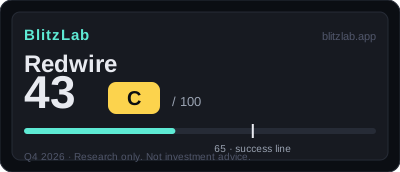
Redwire — Blitz Index 43 (C)
An acquisition blitz in space parts — headline growth, organic near zero.
Confidence: High · Category: frontier
Score breakdown
| Section | Score | Detail |
|---|---|---|
| A · Speed | 14 / 25 | Q2 +89.6% YoY ($117.1M) headline — organic growth ≈ 0; Edge Autonomy is the driver |
| B · Moat | 30 / 60 | Record backlog $542.1M, LTM book-to-bill 1.52; ROSA flight heritage is a qualification moat |
| C · Creative destruction | 6 / 15 | Edge UAS displaces some prime drone territory — but the core parts business supplies rather than disrupts |
| D · BlitzFailing | −7 | Debt is light ($48.6M) — the capital cost is dilution (67M → 155M+ shares); material-weakness history |
Radar axes (0–100): Moat 50 · Speed 56 · Creative 40.
Watch item
Gates: G1 pass (confirmed) · G2 pass (estimated, mid confidence). First scored. The A1 organic/inorganic split rule (IONQ·RDW precedent).
Strengths
- $350M+/quarter order intake for two straight quarters
- FY2026 guidance implies +41.6% at midpoint
- Q2 gross margin 27.8% — a record, from defense-tech mix
- Space + defense UAS cross-selling just beginning
Concerns
- Organic growth near zero — the blitz is bought
- $100M 15–18% seller note; ~$105M preferred-stock overhang
- 2021 accounting investigation closed clean — but internal-control weaknesses persist in filings
- Derivative suit (Yingling, 2022) in early discovery — 'may be material'
Research notes
1. Current Position
Redwire is on the stand to **convert acquired growth into organic growth**. Q2 2026 revenue of $117.1M (+89.6% YoY, SEC confirmed) should not be read as the headline states, but through the CFO's earnings-call remark that the Edge Autonomy acquisition's (closed 2025-06-13, $925M) contribution was the "primary driver" of the defense-tech surge (press-reported). Decompose the segments: Defense Tech $61.9M (prior-year $5.1M) vs Space $55.2M (prior-year $56.7M — a slight decline, with segment adj. EBITDA of −$4.2M). **Strip out the acquisition and organic growth is ≈ 0.** That is the first reason for 43/C — 22 points below the threshold. The model looks at *who* grew, not the headline growth rate.
2. Blitzscaling Lens
**Rule 8. Raise Too Much Money — bought time with dilution instead of debt.** Redwire is a variant execution of Rule 8. Of the $925M Edge Autonomy price, $765M was paid in stock. The lightness of $48.6M in LT debt is not "soundness" but the price paid in dilution instead — a $260M raise (2025-06-18) → a large additional raise during Q2 (cash $144.5M → $557.0M) → a $90M term-loan consortium. Capital access itself is proven (A2 4 points). But unlike Rule 8's original purpose ("prevent mid-race cash depletion"), here the raised money bought acquisitions, not runway. Dilution is an irreversible cost once paid — the market's −20% reaction to the 2025-06 raise announcement (press-reported) was part of that price. The fuel of "bought growth" is the next acquisition, and that fuel is dilution.
3. Competitive Landscape
**The designated comparison axis is IONQ.** As the score file puts it, the same species — "acquisition blitz" — where the gap between headline growth and organic growth is the scoring core. The difference: IONQ's acquisitions buy technology optionality (quantum); Redwire's buy a contract pipeline (defense UAS). It is no coincidence that v1.1 candidate 1 ("the A1 separation rule for acquired growth") emerged from both companies — an empirical case for why the model does not take headline growth rates at face value.
4. Inflection Points
**Inflection Point 1. The conversion speed of the backlog — do orders become revenue.** What to watch: at Q3 2026 earnings (expected November), whether revenue is on track for FY2026 guidance ($450–500M), whether book-to-bill holds above 1.4x, and whether the conversion pace of the $542.1M backlog into recognized revenue accelerates. As the directional assessment states, "the speed at which the backlog converts into recognized revenue is everything the next scoring holds." The key observation: whether Defense Tech segment revenue is maintained or expanded sequentially — if it bends, that is "the acquisition blitz running out of fuel." Link: B2 10 points is a score on the award pipeline. If recognized revenue does not follow, B2 is discounted. Before v1.1 candidate 3 ("the B2 weighting of government-contract backlog — contracted vs IDIQ") is formalized, confirming by disclosure how much of the current $542.1M is genuinely contracted is the observer's share of the work.
5. One-Line Risk
When bought growth stops, what remains is the legacy — the moment Edge's UAS momentum bends or the integration stumbles, Q2's +89.6% evaporates in a single quarter, leaving a shrinking space-components business and a doubled share count.
1. Current Position
Redwire is on the stand to **convert acquired growth into organic growth**. Q2 2026 revenue of $117.1M (+89.6% YoY, SEC confirmed) should not be read as the headline states, but through the CFO's earnings-call remark that the Edge Autonomy acquisition's (closed 2025-06-13, $925M) contribution was the "primary driver" of the defense-tech surge (press-reported). Decompose the segments: Defense Tech $61.9M (prior-year $5.1M) vs Space $55.2M (prior-year $56.7M — a slight decline, with segment adj. EBITDA of −$4.2M). **Strip out the acquisition and organic growth is ≈ 0.** That is the first reason for 43/C — 22 points below the threshold. The model looks at *who* grew, not the headline growth rate.
The second reason is the quality of speed. Speed (A) is 14/25 — 56.0 on the 100-point scale, a different world from the neocloud cohort's 80s. The limitation of the acquisition-roll-up blitzer: the score does not applaud "bought revenue."
But the order momentum is real. Contract backlog of $542.1M — an all-time high (2026-06-30, company release), book-to-bill of 1.42 (Q2) / 1.52 (LTM), $350M+ in orders across two quarters, and FY2026 guidance of $450–500M (midpoint +41.6%, maintained). The speed at which the backlog converts into recognized revenue is everything the next scoring holds — current B2 (distribution scalability) 10 points carry that expectation.
The financial structure has two faces. Gross margin of 27.8% (a Q2 record, reversed from −30.9% a year earlier, SEC confirmed) is the proof of a production turnaround. But GAAP net loss is −$41.0M per quarter with adj. EBITDA at −$3.2M — profitability is still far off. The balance sheet is light (LT debt $48.6M) — yet the share count has more than doubled from 67M to 155M+. **The acquisition was paid in dilution, not debt** — that is this company's grammar of capital. Liquidity of $607.8M (company release) is a cushion, but the ~$105M convertible-preferred overhang (SEC confirmed) and the PE-majority ownership structure sit on top of it.
The GATE verdict: G1 (sustained growth or a second growth curve) is a PASS — with a tail attached: "a PASS in an unproven-organic-growth state." G2 (10-year ceiling ≥ 10x current revenue, bar ≈ $4.26B) is a PASS (estimate) — the combined TAM of space-infrastructure components and defense UAS (industry estimates), with the DoD FY2026 unmanned-systems budget of $16.4B (press-reported) alone worth ~4x the bar.
**Two-sided assessment (per the score file):** - **On the upside:** contract backlog $542.1M at an all-time high + book-to-bill 1.52 — order visibility · gross margin 27.8% (reversed from −30.9% prior year) — proof of the production turnaround · liquidity $607.8M — capital headroom · the high-margin mix of Defense Tech + Octopus ISR deliveries at +15% YoY · FY2026 guidance midpoint of +41.6% — room for re-rating if backlog conversion proves out in the second half. - **On the downside:** most growth is acquisition-driven — organic growth unproven (legacy space segment slightly declining) · still GAAP-negative (−$41.0M per quarter) with adj. EBITDA at −$3.2M — timing of the turn to profitability unconfirmed · dilution from repeated equity raises (67M → 155M+ shares) · history of a material weakness in internal controls plus ongoing derivative litigation ("may be material" in loss magnitude) · the ~$105M convertible-preferred overhang + PE-majority structure · lumpiness of government contracts — award timing volatility becomes earnings volatility.
The directional assessment is **"awaiting integration proof"** — the score's direction hinges on organic-growth proof in H2 2026. Hitting the $450–500M guidance opens a re-rating toward combined "acquired + organic" growth; if the legacy segment keeps shrinking, the headline growth rate evaporates in a single quarter. **Atlas v2 classification: ignition in progress (acquisition-led).** A type absent from the first atlas (the 65+ club) — registered with IONQ as a separate "acquisition blitz" watch item, for cases where the revenue explosion is evidence of acquisition rather than organic growth.
2. Blitzscaling Lens
**Rule 8. Raise Too Much Money — bought time with dilution instead of debt.** Redwire is a variant execution of Rule 8. Of the $925M Edge Autonomy price, $765M was paid in stock. The lightness of $48.6M in LT debt is not "soundness" but the price paid in dilution instead — a $260M raise (2025-06-18) → a large additional raise during Q2 (cash $144.5M → $557.0M) → a $90M term-loan consortium. Capital access itself is proven (A2 4 points). But unlike Rule 8's original purpose ("prevent mid-race cash depletion"), here the raised money bought acquisitions, not runway. Dilution is an irreversible cost once paid — the market's −20% reaction to the 2025-06 raise announcement (press-reported) was part of that price. The fuel of "bought growth" is the next acquisition, and that fuel is dilution.
**Rule 5. Let Fires Burn — the big fire is proving organic growth; the small fires are lawsuits and overhang.** Redwire's true big fire is **whether Edge's UAS momentum can carry the legacy space business up with it**. The legacy space segment shrank year over year in Q2 and its segment adj. EBITDA turned negative — in the first year of post-acquisition integration, the math is reading "1+1=1.8" rather than "1+1=2.5." The small fires are many: the 2021 accounting investigation (closed 2022-03 with no charges, but the material-weakness history persists in filings), ongoing derivative litigation ("may be material"), and the ~$105M convertible-preferred overhang. From Rule 5's view the small fires are not lethal — but when the big fire (organic-growth proof) is out, the market's credit flows to the small fires first. That is the weight of D2 −3 — nearly half of D −7 — the price of that credit.
**Rule 9. Evolve Your Culture — a space-parts company merging with a defense-UAS company.** One year after the Edge closing, two different DNAs sit under one roof (the qualification culture of space hardware vs the delivery speed of defense UAS). Rule 9 says to deliberately redesign the culture as the stage changes. Redwire's gross-margin reversal from −30.9% to +27.8% signals a "development-to-production" transition — an evolution of process rather than culture, but the same direction. The real test is still ahead: whether the defense-tech mix's high margins can structurally lift the legacy space business's low margins. If not, this merger "bought revenue," not "changed the company."
3. Competitive Landscape
**The designated comparison axis is IONQ.** As the score file puts it, the same species — "acquisition blitz" — where the gap between headline growth and organic growth is the scoring core. The difference: IONQ's acquisitions buy technology optionality (quantum); Redwire's buy a contract pipeline (defense UAS). It is no coincidence that v1.1 candidate 1 ("the A1 separation rule for acquired growth") emerged from both companies — an empirical case for why the model does not take headline growth rates at face value.
**The relationship with defense primes is "absorption," not "displacement."** C1 (displaced order) 2 points — Edge UAS partially displaces incumbents' drone territory, but the core space-components business is on the "supplying" side of the order. ROSA solar arrays' flight heritage is the space industry's qualification moat (the basis of B1 6 points) — but not a network effect: a components supplier does not "make" demand, it "receives" and sells it. Distribution is captive to the government-procurement channel.
**The structural competitor is the lumpiness of the award pipeline itself.** Government contracts are a re-compete structure — the backlog is "contracted," not "locked in" (C2 2 points). The moment the $350M+-in-two-quarters momentum breaks, book-to-bill falls below 1.0x. The enemy is not a competitor but the procurement cycle.
4. Inflection Points
**Inflection Point 1. The conversion speed of the backlog — do orders become revenue.** What to watch: at Q3 2026 earnings (expected November), whether revenue is on track for FY2026 guidance ($450–500M), whether book-to-bill holds above 1.4x, and whether the conversion pace of the $542.1M backlog into recognized revenue accelerates. As the directional assessment states, "the speed at which the backlog converts into recognized revenue is everything the next scoring holds." The key observation: whether Defense Tech segment revenue is maintained or expanded sequentially — if it bends, that is "the acquisition blitz running out of fuel." Link: B2 10 points is a score on the award pipeline. If recognized revenue does not follow, B2 is discounted. Before v1.1 candidate 3 ("the B2 weighting of government-contract backlog — contracted vs IDIQ") is formalized, confirming by disclosure how much of the current $542.1M is genuinely contracted is the observer's share of the work.
**Inflection Point 2. Proof of organic growth — the legacy space segment's rebound.** What to watch: whether legacy space segment revenue turns positive year over year, and whether segment adj. EBITDA (−$4.2M) returns to profitability. The moment Q2's "legacy down + Edge surging" structure becomes "both growing" is the verdict day of the acquisition blitz. If it never changes, Redwire remains "a company that buys revenue." Link: A1 4 points "reflects the limit of acquired growth." Proven organic growth removes A1's discount; unproven, the headline +89.6% dissolves into next quarter's base effect.
**Inflection Point 3. The race between dilution and profit — does the price of capital turn into earnings.** What to watch: the narrowing trajectory of GAAP net loss (−$41.0M per quarter) and adj. EBITDA (−$3.2M), whether further raises occur, and the conversion/redemption schedule of the ~$105M convertible preferred. The observation point is the pace at which per-share metrics absorb the dilution at 155M+ shares. Liquidity of $607.8M buys time — but the time has already been paid for. Link: D1 −2 is the score of "balance-sheet lightness," but the real cost of capital is dilution. If v1.1 candidate 2 ("the D1 subdivision of dilution-based expansion capital") is formalized, this structure will be reflected more precisely in the deductions.
**Observation checklist (quarterly):** ① whether quarterly revenue enters the guidance trajectory ② book-to-bill staying at 1.4x+ ③ the legacy space segment's revenue and EBITDA rebound ④ narrowing of GAAP net loss ⑤ further raises and convertible-preferred developments ⑥ the derivative litigation's progress. ①·② are "orders" metrics, ③·④ are "substance" metrics, ⑤·⑥ are "credit" metrics. If only the orders metrics look good and the substance metrics never follow, 43/C will be recorded as "the peak of the acquisition blitz."
5. One-Line Risk
When bought growth stops, what remains is the legacy — the moment Edge's UAS momentum bends or the integration stumbles, Q2's +89.6% evaporates in a single quarter, leaving a shrinking space-components business and a doubled share count.
*BlitzLab v1.0 (frozen). Unconfirmed figures must carry estimate/press-reported labels.* *For education and research purposes only. Not a recommendation to buy, sell, or hold any security.*
Site Summary
Redwire is on the stand to convert acquired growth into organic growth at 43/C — 22 points below the threshold. Q2 2026 revenue of $117.1M (+89.6% YoY) was driven by the Edge Autonomy acquisition (closed 2025-06-13, $925M); stripping it out, organic growth is ≈ 0. Speed (A) at 14/25 (56.0 converted) reflects the limit of the acquisition-roll-up blitzer — the score does not applaud bought revenue. - But the order momentum is real: a record $542.1M backlog, book-to-bill of 1.42 (Q2)/1.52 (LTM), $350M+ in two quarters of orders, and FY2026 guidance of $450–500M (midpoint +41.6%). Gross margin of 27.8% (reversed from −30.9%) is the production turnaround's proof. The backlog's conversion speed into recognized revenue is everything the next scoring holds. - Rule 8 was executed as dilution instead of debt: $765M of the $925M deal paid in stock, share count more than doubled (67M → 155M+), while LT debt sits at $48.6M. Liquidity of $607.8M is headroom, but the ~$105M convertible-preferred overhang and PE-majority structure weigh on it. Dilution is irreversible — the market's −20% reaction to the 2025-06 raise was part of the price. - The designated comparison axis is IONQ — the same "acquisition blitz" species where the headline-vs-organic gap is the scoring core. The defense-prime relationship is absorption, not displacement; the structural competitor is the award pipeline's lumpiness itself. - Inflection points to watch quarterly: ① backlog-to-revenue conversion speed and whether Defense Tech holds up sequentially ② the legacy space segment's revenue and EBITDA rebound — the verdict day of the acquisition blitz ③ the narrowing of GAAP losses and further raise developments. Atlas v2 classifies this as ignition in progress, acquisition-led. - One-line risk: the moment Edge's UAS momentum bends, Q2's +89.6% evaporates in a quarter, leaving a shrinking space business and a doubled share count.
*Translated from the Korean edition (2026-10-15). For education and research purposes only. Not a recommendation to buy, sell, or hold any security.*
More Frontier companies
Other Frontier names on the Blitz Index, highest score first: Rocket Lab (62/B), Tesla (62/B), Insulet (57/C).
Next earnings
Nov 4, 2026 · After close · Expected
Coverage
As of October 2026 · Model v1.0 (frozen) · Confidence: High (listed, SEC filings) · Not investment advice — a scholar's assessment.
Embed this score
Copy the HTML below to show this score on your site. The badge links back to this page and updates automatically when the score changes.
Preview:
BlitzLab scores businesses against a scholar’s standard — not investment advice. No price targets, no buy/sell recommendations. Figures are from SEC filings (XBRL) as labeled in the source scorecard.