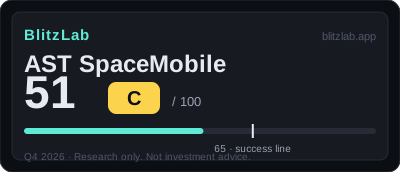
AST SpaceMobile — Blitz Index 51 (C)
The orbital blitz — building the constellation before the service exists.
Confidence: Medium · Category: frontier
Score breakdown
| Section | Score | Detail |
|---|---|---|
| A · Speed | 19 / 25 | Revenue +2,626% YoY (Q2) — but from gateway hardware + government milestones |
| B · Moat | 33 / 60 | Backlog $1.30B (~11x TTM); 60+ MNO partners covering 3B subscribers |
| C · Creative destruction | 8 / 15 | New connectivity category; government demand as second axis |
| D · BlitzFailing | −9 | Debt $4.1B = ~36x TTM; FCC 2030 milestone risk; Starlink D2D competition |
Radar axes (0–100): Moat 55 · Speed 76 · Creative 53.
Watch item
Gates: G1 conditional pass (no commercial service revenue yet) · G2 pass (estimated).
Strengths
- Backlog $1.30B (~11x TTM) — commercial + US government (SEC)
- 60+ MNO partnerships, 3B subscriber coverage
- FY2026 guidance $150–200M maintained (SEC)
- Pro forma cash $3.7B+ funds build-out (1.625% converts)
Concerns
- Commercial service delayed to early 2027 — PMF validation still a year out
- Current revenue is hardware + milestones, not service
- Launch bottleneck: dependent on New Glenn/SpaceX
- FCC 2030-08 milestone (124 satellites) — license risk if missed
Research notes
1. Current Position — The construction stretch of the orbital blitz (satellites exist, service does not)
AST SpaceMobile is **"build before demand" in its orbital edition**. FY2024 revenue of $4.418M → FY2025 $70.918M (+1,505%, confirmed via SEC 10-K) → H1 2026 $46.255M (SEC 10-Q), Q2 2026 $31.52M (+2,626% YoY) — the curve is explosive, but this revenue is not commercial direct-to-device (D2D) service revenue. It is gateway hardware deliveries plus U.S. government milestones (company release, confirmed via SEC 8-K exhibit). Commercial service has been deferred to early 2027 (July 2026 8-K) — for lack of rockets.
2. Blitzscaling Lens — The Three Sharpest Rules
**Rule 8. Raise Too Much Money — executed, but with "cheap borrowed money."** ASTS executes Rule 8 through low-coupon convertibles. July's $1.15B 1.625% convertible (conversion price $149.20), multiple convertibles maturing 2032 and 2036 — coupons of 1.625%–4.25%, long maturities (2032–2036). The result is extreme: pro forma total debt of ~$4.1B = ~36x TTM (APLD-level multiples), yet quarterly interest of $26.1M vs interest income of $27.7M leaves **net interest ≈ zero**. The D1 −8 rests on the absolute multiple (36x); it avoided −10 because of coupon, maturity, and cash coverage ($3.7B > debt). That is why the score file proposes v1.1 candidate 3 ("D1 on a net-interest basis") — it is not only the debt's size that differs, but the money's quality. The price is being paid in dilution, though: shares outstanding +5.0% in six months, convertible share settlements (1.86M + 4.48M shares) plus warrant exercises (4.82M shares), $800M ATM remaining. "Built with borrowed money and printed shares" — the speed of capital is sustained by gnawing at shareholders' share.
3. Competitive Landscape — An Oligopoly with Starlink; MNOs as ASTS's "Satellite Division"
**The designated competitor** is SpaceX's Starlink D2D. Live in operation with T-Mobile — against which ASTS is still pre-beta. The axis of difference is architecture: ASTS is native cellular (works with existing base-station equipment, traffic stays domestic → regulator- and MNO-friendly, 8-K exhibit) while Starlink runs its own terminal ecosystem. Amazon Leo (formerly Kuiper) is also entering — the score file discounts (G2 passes but B1 and C are discounted) toward **an oligopoly structure** rather than winner-take-all.
4. Inflection Points — The Three Points That Will Decide Success
**Inflection Point 1. Commercial service launch (early 2027) — the final PMF verification.** What to watch: adherence to the late-2026 beta schedule (company release, 8-K exhibit), then proof of consumer paid conversion after the early-2027 commercial launch. Current revenue (Q2 $31.52M) is entirely hardware deliveries plus government milestones — the quarter when service revenue recognition begins is the transition from conditional to confirmed G1. Whether the FY2026 guidance of $150–200M stays "maintained" or gets deferred is the first observation metric. Link: the score file's verdict — "everything at the next scoring (after commercial service launch)." The conditions for A1 8→10 points ("upon proof of commercial-service revenue recognition") and B4 5 points upward ("upon proof of the high-margin core") both hang on this point. If the beta slips, 51/C stays "a company of contracts."
5. One-Line Risk
Without rockets, satellites are warehouse inventory — ASTS's blitz rides not on its own factories but on someone else's rockets, and $3.7B of cash buys time but not launch slots.
1. Current Position — The construction stretch of the orbital blitz (satellites exist, service does not)
AST SpaceMobile is **"build before demand" in its orbital edition**. FY2024 revenue of $4.418M → FY2025 $70.918M (+1,505%, confirmed via SEC 10-K) → H1 2026 $46.255M (SEC 10-Q), Q2 2026 $31.52M (+2,626% YoY) — the curve is explosive, but this revenue is not commercial direct-to-device (D2D) service revenue. It is gateway hardware deliveries plus U.S. government milestones (company release, confirmed via SEC 8-K exhibit). Commercial service has been deferred to early 2027 (July 2026 8-K) — for lack of rockets.
And yet this is exactly why G1 is a conditional pass, and why it is this company's thesis. 60+ MNO partnerships covering a combined 3 billion subscribers (company release, 8-K exhibit) — carriers putting their own money on the line. A contracted backlog of ~$1.30B (commercial contracts plus U.S. government awards, 8-K exhibit) = ~11x TTM revenue (~$115.3M, estimate). U.S. government awards of $125M+ (national security use). The "contracted demand" level of PMF evidence is the strongest form available at the pre-commercial stage — why the score file applied the CIFR (32/D) precedent. The conditionality attaches because consumer paid conversion cannot be verified until after the beta (planned late 2026).
The GATE verdict: G1 (sustained growth or a second growth curve) is a conditional pass (press-reported) — the $1.30B contracted backlog and 60+ MNOs are the evidence. G2 (10-year ceiling ≥ 10x current revenue, bar ≈ $1.153B) is a pass (estimate) — the contracted backlog alone is ~11x the bar; the D2D market at $12B by 2030 (Omdia, press-reported). Both gates were passed "on contracts and market size": the evidence of growth is not recognized revenue but signed futures.
**The constraint is not manufacturing — it is launch.** Satellite production is ahead of launch — a manufacturing cadence target of six satellites per month, 95% built in-house (earnings call, press-reported), 13 satellites in orbit, BlueBird 14–16 about to ship, 17–46 in production (8-K exhibit). But reaching the 45 satellites needed for continuous coverage (early-2027 target), 90 for global coverage, and 124 by the FCC's August-2030 milestone requires rockets. With New Glenn grounded after the explosion, the company is effectively dependent on SpaceX — a competitor — and schedule control sits with someone else. The commercial-launch deferral is the proof of this structural risk.
**Two-sided assessment (per the score file):** - **On the upside:** contracted backlog of $1.30B (~11x TTM, confirmed via SEC 8-K exhibit) · 60+ MNO partnerships and 3-billion-subscriber coverage — the strongest pre-commercial PMF form · FY2026 guidance of $150–200M maintained, Q4-weighted · pro forma cash of $3.7B+ ($2.7B at 6/30 plus July's $1.15B 1.625% convertible) — construction funding through the 2030s · the scale-economy path at $21–23M per satellite plus the in-house ASIC (10GHz processing bandwidth, press-reported) · government expansion (J-LEO $1B non-dilutive government capital pre-selected, USG $125M+ awards — press-reported). - **On the downside:** commercial service deferred to early 2027 — the final PMF verification (consumer paid conversion) is more than a year out · current revenue is hardware deliveries plus government milestones — service margins unproven; Q2 blended gross margin of 25.2% (the 83.7% service figure reflects milestones, not business margin) · launch bottleneck: New Glenn grounded, dependent on SpaceX · the FCC's August-2030 milestone (124 satellites) — license risk if missed · ongoing dilution: Class A shares outstanding +5.0% in six months, weighted average +26.5% YoY (SEC confirmed), $800M ATM program remaining · Starlink D2D (operating with T-Mobile, live) and Amazon Leo — the possibility of oligopoly rather than winner-take-all competition · Q2 involuntary conversion loss of $125.9M (satellite loss, SEC confirmed).
The directional assessment is **"construction execution sprint"** — the score has exactly one direction: speed of satellites to orbit. The late-2026 beta and the early-2027 commercial launch are Act 1's first scenes.
2. Blitzscaling Lens — The Three Sharpest Rules
**Rule 8. Raise Too Much Money — executed, but with "cheap borrowed money."** ASTS executes Rule 8 through low-coupon convertibles. July's $1.15B 1.625% convertible (conversion price $149.20), multiple convertibles maturing 2032 and 2036 — coupons of 1.625%–4.25%, long maturities (2032–2036). The result is extreme: pro forma total debt of ~$4.1B = ~36x TTM (APLD-level multiples), yet quarterly interest of $26.1M vs interest income of $27.7M leaves **net interest ≈ zero**. The D1 −8 rests on the absolute multiple (36x); it avoided −10 because of coupon, maturity, and cash coverage ($3.7B > debt). That is why the score file proposes v1.1 candidate 3 ("D1 on a net-interest basis") — it is not only the debt's size that differs, but the money's quality. The price is being paid in dilution, though: shares outstanding +5.0% in six months, convertible share settlements (1.86M + 4.48M shares) plus warrant exercises (4.82M shares), $800M ATM remaining. "Built with borrowed money and printed shares" — the speed of capital is sustained by gnawing at shareholders' share.
**Rule 5. Let It Burn — one big fire, the launcher; the small fires, lost satellites.** Hoffman's fire priority is "extinguish only the fires that can kill the company; let the small ones burn." ASTS's one true big fire is **whether 45 satellites can get to orbit** — the launch schedule. The New Glenn explosion → commercial-launch deferral → SpaceX dependence. Ten contracted launches (two providers, earnings call, press-reported) exist, but without rockets the satellites are warehouse inventory. The Q2 involuntary conversion loss of $125.9M (satellite loss) is a "small fire" — disclosed, one-off, not accounting fraud (D2 no-trigger). Dilution is also a small fire — distracting but not lethal. But a company with many small fires gets no credit from the market when the big fire breaks out — which is how D1 −8 and D3 −1 come to sum together.
**Rule 4, modified — satellites before service: the "embarrassing product" in its orbital edition.** Blitzscaling says "launch an embarrassing product and patch it" (Rule 4), but **a satellite constellation cannot be patched like software** — launched satellites cannot come back. ASTS executes a variant: infrastructure (satellites) before product (commercial service). Beta is planned for late 2026, commercial launch for early 2027 — construction precedes "launch" in this pre-commercial blitz. On applicability conditions ASTS differs from the archetype: network effects (B1 7 points — "none yet"), no virality. Instead the winner-take-all reward sits in the **supply-side moat of scarce resources** — spectrum and orbital slots (targeting ~100MHz in the U.S. and 60+MHz globally, 8-K exhibit) — and preempting the distribution network of 60+ MNOs. The five-growth-lever analysis (score file) verdict — primary lever distribution (orbit, spectrum) + capital, secondary lever technology (ASIC), weak lever network effects — is the declaration of the "orbital blitz." Same "heavy-equipment blitz" family as the neoclouds, but what's sold is **connectivity**, not compute.
3. Competitive Landscape — An Oligopoly with Starlink; MNOs as ASTS's "Satellite Division"
**The designated competitor** is SpaceX's Starlink D2D. Live in operation with T-Mobile — against which ASTS is still pre-beta. The axis of difference is architecture: ASTS is native cellular (works with existing base-station equipment, traffic stays domestic → regulator- and MNO-friendly, 8-K exhibit) while Starlink runs its own terminal ecosystem. Amazon Leo (formerly Kuiper) is also entering — the score file discounts (G2 passes but B1 and C are discounted) toward **an oligopoly structure** rather than winner-take-all.
**Structurally, ASTS is the MNOs' "satellite division."** The top-3 U.S. MNOs' JV plans (8-K exhibit) show carriers staking spectrum and customers on satellites, even as they are 60+ partners. This is a dual structure of customers that are also the distribution network — "customer-partner duality," distinct from the neoclouds' "customer-competitor duality." The J-LEO $1B non-dilutive government capital (Japan, pre-selected — press-reported) and the USG $125M+ awards build a second demand axis outside commercial.
**The direction of creative destruction:** C1 (displaced order) 3 points — a new category aimed at "billions unconnected," an **expansion that fills a gap** rather than one that displaces the existing telecom order. Consistent with Ledger insight ① (15 of 16 cases are pie-expansion). The order is expanding into government use (non-telecom, radar, emergency response, IoT, AI edge), but with no commercial service yet, there is no proof of destruction. The real threat is not an outside destroyer but kin — the "spectrum-and-slot land grab" with Starlink and Leo racing for the same orbits.
4. Inflection Points — The Three Points That Will Decide Success
**Inflection Point 1. Commercial service launch (early 2027) — the final PMF verification.** What to watch: adherence to the late-2026 beta schedule (company release, 8-K exhibit), then proof of consumer paid conversion after the early-2027 commercial launch. Current revenue (Q2 $31.52M) is entirely hardware deliveries plus government milestones — the quarter when service revenue recognition begins is the transition from conditional to confirmed G1. Whether the FY2026 guidance of $150–200M stays "maintained" or gets deferred is the first observation metric. Link: the score file's verdict — "everything at the next scoring (after commercial service launch)." The conditions for A1 8→10 points ("upon proof of commercial-service revenue recognition") and B4 5 points upward ("upon proof of the high-margin core") both hang on this point. If the beta slips, 51/C stays "a company of contracts."
**Inflection Point 2. Launch cadence — a blitz hanging on someone else's rockets.** What to watch: the growth of the on-orbit count (13 → the 45 target, early 2027). Execution of the ten contracted launches (two providers), New Glenn's return schedule, SpaceX launch-slot availability. For the $21–23M per-satellite capital cost (at 90+ units, earnings call, press-reported) to work as scale economics, the path must run 90 → 124 satellites. The FCC's August-2030 milestone (124 satellites) is tied directly to the license — missing it is license risk (D4 recorded item). Link: whether B2 11 points' discount factor ("distribution expansion bound to a third-party bottleneck beyond the company's control") is removed. The live case of the score file's v1.1 candidate 2 ("external-bottleneck B2"). If the launch schedule slips a year, the $3.7B cash endures — but the FCC milestone wobbles.
**Inflection Point 3. The $1.30B backlog's conversion — the recognition speed of the "sold future."** What to watch: whether the service-revenue share of quarterly revenue moves off zero. Changes in backlog composition — commercial contracts vs government awards, the J-LEO $1B's pre-selected→confirmed conversion. The 10-Q's RPO and deferred-revenue lines are also observation metrics. Watch for a SYM-style "vast majority" concentration phrase appearing later — currently dispersed across 60 MNOs, but the concentration of actual revenue contribution is unconfirmed. Link: v1.0's structural blind spot — the $1.30B backlog is not directly scored (the same structure as CRWV's $104B). Only recognized revenue moves the score — why 51/C is "a company of contracts," and the item that will move first (A1, B4) when conversion begins.
**Observation checklist (quarterly):** ① adherence to the beta schedule (planned late 2026) ② progress of the on-orbit count 13 → 45 ③ the service-revenue share of quarterly revenue ④ whether FY2026 guidance of $150–200M is maintained ⑤ the burn rate of pro forma cash $3.7B (against H1 capex of $859M) ⑥ FCC milestone progress ⑦ commercial progress at Starlink D2D and Amazon Leo. ①·②·③ are "proof" metrics, ④·⑤ are "firewall" metrics, ⑥·⑦ are "structure" metrics. If proof metrics trend up, 51/C rises in the "construction sprint" direction. If beta delays meet launch disruptions, even the ≈zero-net-interest firewall cannot stop the speed of dilution.
5. One-Line Risk
Without rockets, satellites are warehouse inventory — ASTS's blitz rides not on its own factories but on someone else's rockets, and $3.7B of cash buys time but not launch slots.
*BlitzLab v1.0 (frozen 2026-10-10). Verified edition.*
*Translated from the Korean edition (2026-10-15). For education and research purposes only. Not a recommendation to buy, sell, or hold any security.*
More Frontier companies
Other Frontier names on the Blitz Index, highest score first: Rocket Lab (62/B), Tesla (62/B), Insulet (57/C).
Next earnings
Nov 9, 2026 · After close · Expected
Coverage
As of October 2026 · Model v1.0 (frozen) · Confidence: Medium (listed, SEC filings; some items estimated or press-reported) · Not investment advice — a scholar's assessment.
Embed this score
Copy the HTML below to show this score on your site. The badge links back to this page and updates automatically when the score changes.
Preview:
BlitzLab scores businesses against a scholar’s standard — not investment advice. No price targets, no buy/sell recommendations. Figures are from SEC filings (XBRL) as labeled in the source scorecard.